
If you have ever booked in for a “clean” and then been offered a few options, you are not alone. The terms get used interchangeably, but they do different jobs. Choosing the right one is about improving gum health, reducing build-up, and keeping things comfortable, not just chasing that smooth feeling (though we won’t pretend that part isn’t satisfying).
Here’s the simplest way to think about airflow, teeth cleaning vs scale and polish:
- Scaling removes hardened build-up (tartar, also called calculus) that you typically cannot remove fully at home.
- Polishing smooths the tooth surface and lifts light surface staining after scaling.
- Airflow cleaning (air polishing) uses a controlled mix of air, water and fine powder to remove soft plaque biofilm and surface stains, including in awkward areas.
In real appointments, we often combine these. What you need depends on what we find when we examine your teeth and gums.
What we’re actually removing: plaque, tartar and stain
Plaque (also called biofilm) forms every day. It is a sticky layer of bacteria that builds up on teeth, around the gumline and between teeth. If plaque is left in place long enough, minerals in saliva can harden it into tartar (calculus). Once it has hardened, it typically can’t be removed fully with brushing and flossing alone.
Staining is separate. Some staining sits on the surface (often from tea, coffee, red wine or smoking), while deeper colour changes inside the tooth are more likely to need whitening or other cosmetic options.
If you want a quick explanation of one of the biggest culprits, our guide covers why coffee can stain teeth.
Scaling: the “heavy lifting” for tartar
Scaling targets hardened deposits. When calculus is present, scaling is usually the appropriate method because tartar is firmly attached to the tooth surface. Polishing and Airflow are not designed to detach heavy calculus.
What scaling removes
Scaling is designed to remove:
- Tartar (calculus) above the gumline
- Deposits close to the gumline (and where appropriate, carefully around the gumline)
- Plaque sitting on top of tartar
In practice, a common pattern is a build-up behind the lower front teeth and around the back molars. Those areas catch plaque easily and tend to mineralise more quickly.
How scaling is done
We may use:
- Ultrasonic instruments (vibration plus water) to break up deposits
- Hand instruments for precision, especially in tighter areas
What scaling feels like
Most people notice vibration, water spray and a scraping sensation in certain spots. If gums are inflamed or you have exposed root surfaces, some areas can feel sensitive. We can adjust the approach to keep things comfortable, so let us know how you are feeling as we go.
A quick note on UK care
In the UK, treatment is guided by what is clinically needed at the time, rather than every appointment automatically including the same steps for everyone. The NHS explains this approach in its overview of what dental services are available.
Polishing: smoothing and finishing, not a substitute for scaling
Polishing is often bundled into “scale and polish”, but polishing alone is not a deep clean. It is best seen as a finishing step.
What polishing does
Polishing can help to:
- Remove light surface staining
- Smooth the tooth surface so it feels cleaner
- Lift leftover soft deposits after scaling
What polishing does not do
Polishing does not remove tartar. If hardened deposits are present, polishing on its own is unlikely to address the main cause of roughness around the gumline.
Airflow cleaning: modern biofilm and stain removal (air polishing)
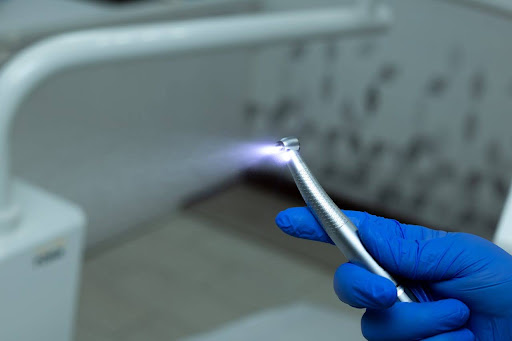
Alternative text: Close-up of a dental handpiece used during professional teeth cleaning in a clinical setting.
Airflow cleaning uses a controlled stream of air, water and a fine powder to remove plaque biofilm and lift surface staining. It can be particularly helpful around areas that trap plaque, such as fixed braces, retainers, bridges and implant restorations.
A 2023 review discusses how low-abrasive powders can be effective for biofilm removal in selected periodontal maintenance situations, alongside safety and comfort considerations. If you would like to see the evidence, read the open-access paper on the subgingival use of air-polishing powders.
Why do many patients like Airflow?
Many patients like Airflow because it can:
- Remove biofilm efficiently
- Lift surface staining effectively
- Feel more comfortable than scraping alone when the main aim is stain and biofilm removal
Airflow is not a whitening treatment. It can reduce external staining and may make teeth look brighter, but it does not change the natural tooth shade. Results vary depending on the type and depth of staining.
Where Airflow has limits
Airflow is not a replacement for scaling when tartar is present. In many cases, a combination of Airflow for biofilm and stain plus targeted scaling where calculus is present can work well.
Airflow teeth cleaning vs scale and polish: quick comparison
| Treatment | Best for | Removes | Typical sensation | Limits |
| Scaling | Tartar control, gum health support | Hardened tartar and attached deposits | Vibration or scraping, water spray | May feel sensitive if gums are inflamed |
| Polishing | Finishing and smoothing | Light surface stains and soft residue | Smooth, mild pressure | Does not remove tartar |
| Airflow cleaning | Biofilm removal and stain lifting | Biofilm and surface staining | Gentle spray sensation | Not designed to detach heavy calculus |
How we decide what you actually need
We do not choose a cleaning option at random. We base it on what we find on examination, how your gums look, and where the build-up collects.
Step 1: We assess gum health
Bleeding and tenderness can be signs of inflammation. If gums are inflamed, the aim is usually to reduce biofilm and remove deposits that contribute to irritation, alongside practical home-care support.
Step 2: We separate “soft” from “hardened”
- Soft plaque biofilm and surface staining often respond well to Airflow and polishing.
- Hardened tartar usually needs scaling.
Step 3: We use a simple checklist
We commonly consider:
- Where tartar is present and how firmly it is attached
- Whether gums bleed easily or look inflamed
- Where plaque tends to collect (especially around appliances or restorations)
- Your stain pattern (tea, coffee, red wine, smoking)
- Sensitivity or recession, which affects how we approach cleaning
Step 4: We avoid one-size-fits-all schedules
There is evidence suggesting routine planned scale and polish on a fixed schedule may make little or no difference to certain gum outcomes for adults without severe periodontitis who already attend regularly, compared with not scheduling it routinely. This is discussed in the Cochrane review on routine scaling and polishing for periodontal health in adults.
The key takeaway is that professional cleaning is most useful when it matches your current gum health and risk, rather than being treated as a standard add-on for everyone.
What a typical appointment may include
Every patient is different, but here is a realistic flow.
- Assessment of gums, plaque, tartar and the areas you find hardest to keep clean.
- Biofilm and stain removal using Airflow, where it suits your needs.
- Targeted scaling where tartar is present.
- Polish if appropriate for a smoother finish.
- Home-care advice focused on what you can actually maintain.
If you wear retainers (or you are planning to), our guide on how to clean orthodontic retainers is worth a look, because retainers can hold onto plaque if cleaning slips.
How to make the results last longer
Professional cleaning helps, but day-to-day habits decide how quickly plaque returns.
- Brush twice daily with a fluoride toothpaste, paying attention to the gumline
- Clean between teeth daily (the best option is the one you will use consistently)
- If you stain easily, rinse with water after tea, coffee or red wine
- If your gums bleed, it can be a sign of inflammation, so continue gently and focus on thorough cleaning
- If you have persistent bleeding, swelling, ongoing pain, or sudden sensitivity, it’s best to get personalised advice rather than relying on general guidance
A natural next step if you want a brighter, more even finish
If your main goal is tackling staining and refreshing the look of your smile, professional cleaning is often a sensible starting point. Once we have removed biofilm and surface stain, you get a clearer picture of your natural tooth shade and whether anything else would add value.
If you are considering a smile refresh, explore our cosmetic dentistry options to see what we can build on a clean, healthy foundation.
In summary
Scaling, polishing and Airflow cleaning each have a role. Scaling removes tartar. Polishing smooths and finishes. Airflow focuses on biofilm disruption and stain lifting, often with good comfort when stain and biofilm are the main targets.
The key takeaway is simple: tartar usually needs scaling, while stain and biofilm often respond well to Airflow and polishing, sometimes alongside targeted scaling.
If you are not sure what you need, we will explain what we are seeing and what we recommend. You can contact our team here.
This article is for general information only and does not replace personalised advice from a dental professional who has assessed you in person.